
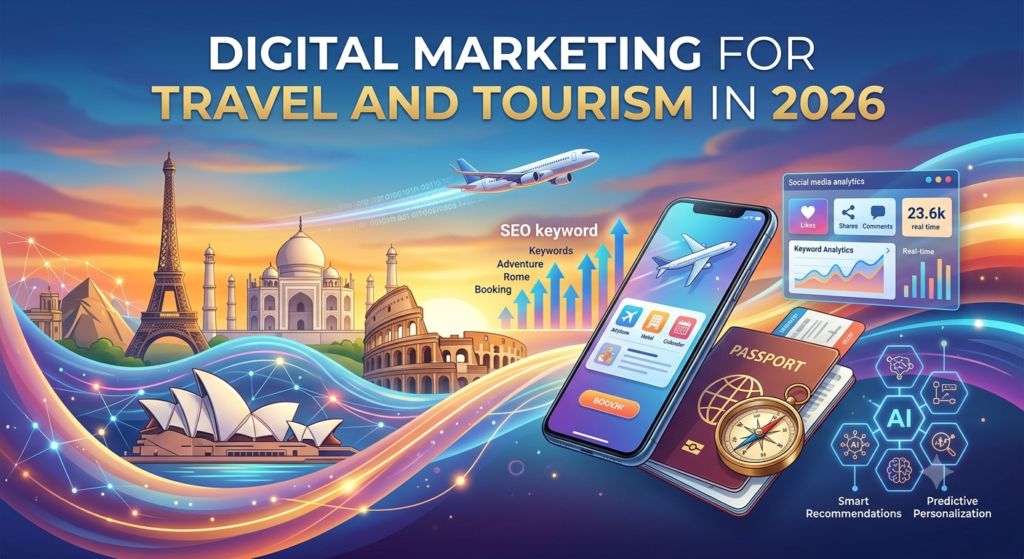
The way people plan and book travel has changed significantly. Travelers no longer depend only on travel agents, brochures, newspapers, or recommendations from friends and family when deciding where to go. Today, the travel journey often begins with a search engine, social media post, travel video, online review, or recommendation generated by a digital platform.
Whether someone is looking for a weekend getaway, an international holiday, a luxury resort, an adventure experience, or a budget-friendly tour, digital channels play an important role in influencing their decisions.
This shift has made digital marketing for travel and tourism an essential part of modern tourism businesses. Travel agencies, tour operators, hotels, resorts, airlines, tourism boards, and experience providers can use digital marketing to reach potential travelers, build trust, showcase destinations, generate inquiries, and increase bookings.
In 2026, simply having a website or social media account is not enough. Travel businesses need a well-planned digital strategy that combines search engine optimization (SEO), content marketing, social media, paid advertising, email marketing, video, personalization, and emerging technologies such as artificial intelligence.
This guide explores the most important travel and tourism marketing strategies businesses can use to attract more travelers, improve their online presence, and compete in an increasingly digital marketplace.
What Is Digital Marketing for Travel and Tourism?
Digital marketing for travel and tourism refers to the use of online channels, platforms, technologies, and marketing techniques to promote destinations, travel services, accommodation, experiences, and tourism-related businesses.
The objective is not limited to generating immediate bookings. A successful digital marketing strategy can help a tourism business attract people at different stages of the travel journey.
For example, a person may initially search for:
“Best places to visit in India”
Later, they may search:
“Best places to visit in Goa in December”
Eventually, they may search:
“Goa tour packages for couples”
Each search represents a different stage of the customer’s decision-making process.
Travel businesses can use digital marketing to appear at these different stages through useful content, search visibility, social media, advertisements, email campaigns, and personalized experiences.
Understanding Digital Marketing in the Travel Industry
Digital marketing in the travel industry can include several different channels:
- Search engine optimization (SEO)
- Content marketing
- Social media marketing
- Google Ads and other paid advertising
- Email marketing
- Video marketing
- Influencer marketing
- Local SEO
- Mobile marketing
- Online reputation management
- AI-powered marketing and personalization
The most effective approach is usually not to depend on one channel. Instead, travel businesses can combine multiple channels according to their target audience, budget, destination, and business objectives.
For example, a local tour operator may focus heavily on local SEO, Google Ads, Instagram, WhatsApp, and destination-focused content. A large hotel chain may use SEO, paid advertising, social media, email marketing, loyalty programs, and data-driven personalization.
Why Digital Marketing Matters for Tourism Businesses
Tourism is a highly visual and experience-driven industry. Travelers want to see destinations, hotels, activities, food, landscapes, and experiences before making a decision.
Digital platforms make it possible for businesses to communicate these experiences before the customer arrives.
A well-executed digital strategy can help a travel business:
- Increase online visibility
- Reach specific traveler segments
- Generate qualified leads
- Promote destinations and packages
- Build brand awareness
- Establish credibility
- Encourage direct bookings
- Improve customer engagement
- Retain previous customers
Digital marketing can also make it easier for smaller tourism businesses to compete for attention alongside larger brands by targeting specific destinations, interests, and traveler groups.
Why Travel and Tourism Businesses Need Digital Marketing in 2026
The travel industry is highly competitive. Travelers have access to thousands of destinations, hotels, tour packages, activities, reviews, videos, and travel websites.
This creates both an opportunity and a challenge.
Businesses that provide useful information and create a strong online presence can become part of the traveler’s research process. Businesses that remain difficult to find online may lose potential customers before they ever make direct contact.
Travelers Start Their Journey Online
For many travelers, the planning process begins long before they contact a travel company.
They may search for destinations, watch travel videos, compare hotels, read reviews, check prices, explore social media, and research itineraries.
This means travel businesses need to be visible during the research phase rather than waiting until the customer is ready to book.
For example, a tourism company selling Rajasthan packages could create content around:
- Best places to visit in Rajasthan
- Rajasthan travel itinerary
- Best time to visit Rajasthan
- Things to do in Jaipur
- Rajasthan travel tips
- Jaipur to Jaisalmer itinerary
- Rajasthan family tour packages
This type of content can attract travelers before they have selected a specific company.
Once users become familiar with the brand, they may be more likely to consider its services when they are ready to book.
Increasing Competition in the Travel Industry
Travelers can compare multiple businesses within minutes.
A person looking for a hotel, tour package, or activity can compare:
- Prices
- Locations
- Reviews
- Photos
- Services
- Customer experiences
- Cancellation policies
- Offers
Because comparison is so easy, businesses need to communicate their value clearly.
A strong online presence can help a company differentiate itself through useful content, professional visuals, positive reviews, transparent information, and a smooth booking experience.
Importance of Online Reviews and Reputation
Online reputation is particularly important in travel and tourism because customers are purchasing an experience that they cannot fully evaluate before the trip.
A traveler may want to know:
- Is the hotel actually as good as the photos?
- Is the tour operator reliable?
- Are the guides professional?
- Is the location convenient?
- Did previous travelers have a good experience?
Reviews can help answer these questions.
Travel businesses should actively monitor reviews on platforms such as Google and relevant travel websites. Responding professionally to both positive and negative feedback can demonstrate that the business values customer experiences.
However, businesses should avoid manipulating or fabricating reviews. Authentic customer feedback is more valuable for building long-term trust.
Top Digital Marketing Strategies for Travel and Tourism
There is no single strategy that works for every tourism business. The ideal digital marketing mix depends on the business model, destination, target audience, budget, and objectives.
However, several strategies are particularly relevant to travel businesses in 2026.
1. Search Engine Optimization (SEO)
SEO is one of the most important long-term strategies for travel businesses.
Tourism SEO involves optimizing websites and content so that travelers can discover a business through search engines when looking for relevant destinations, services, information, or experiences.
Instead of targeting only highly competitive keywords such as “travel agency,” a business can build visibility around specific search intentions.
For example:
- Travel agency in Mumbai
- Goa tour packages
- Best resorts in Lonavala
- Things to do in Dubai
- Best honeymoon destinations in India
- Kerala family tour packages
Keyword Research for Travel Businesses
Keyword research helps identify what potential travelers are searching for.
Travel businesses can organize keywords into different categories.
Informational keywords:
- Best places to visit in Kerala
- Things to do in Manali
- Best time to visit Bali
Commercial keywords:
- Best Goa tour packages
- Dubai holiday packages
- Family tour packages to Kashmir
Transactional keywords:
- Book Goa tour package
- Book hotel in Jaipur
- Maldives resort booking
Creating content around different search intentions can help businesses reach travelers at different stages of the buying journey.
Destination-Based SEO
Destination-based content is particularly valuable for tourism businesses.
Instead of publishing generic articles, businesses can create detailed pages dedicated to specific destinations.
For example, a travel agency specializing in international holidays could create pages for:
- Dubai
- Singapore
- Thailand
- Bali
- Maldives
- Switzerland
Each destination page can include information about attractions, travel seasons, activities, packages, accommodation options, approximate budgets, and frequently asked questions.
Local SEO
Local SEO can be especially useful for travel agencies, hotels, tour operators, and local tourism businesses.
A business should maintain accurate information across its online profiles, including:
- Business name
- Address
- Phone number
- Website
- Opening hours
- Photos
- Services
A properly maintained Google Business Profile can also help a local business appear when users search for relevant services in a particular location.
2. Content Marketing
Travel is naturally suited to content marketing because people frequently research destinations before making decisions.
A tourism business can use content to answer questions, inspire travelers, demonstrate expertise, and introduce its services.
Instead of making every piece of content a direct sales pitch, businesses can create content that genuinely helps travelers.
Types of Travel Content
A travel company could publish:
- Destination guides
- Travel itineraries
- Packing guides
- Travel tips
- Budget guides
- Hotel guides
- Restaurant recommendations
- Activity guides
- Seasonal travel guides
- Travel FAQs
- Customer stories
For example, instead of publishing only:
“Book Our Goa Tour Package”
a company could publish:
“7-Day Goa Itinerary: Beaches, Food, Culture and Things to Do”
At the end of the article, the business can introduce relevant travel packages.
This approach allows the brand to provide value while naturally connecting its services to the reader’s needs.
Why Storytelling Matters
Travel is based on experiences, emotions, and memories. Storytelling can therefore make tourism content more engaging.
A hotel could tell the story of its location and local culture. A tour operator could share customer experiences. A destination brand could showcase local food, traditions, landscapes, and people.
The objective is to help potential travelers imagine what their experience could be like.
3. Social Media Marketing
Social media has become an important channel for travel discovery.
Platforms such as Instagram, Facebook, YouTube, and other short-form video platforms allow tourism brands to showcase destinations visually.
A traveler may discover a destination through a short video, save it for later, share it with friends, and eventually search for accommodation or tour packages.
This creates an opportunity for travel brands to become part of the inspiration stage.
Create Visual Travel Content
Travel businesses should focus on high-quality visual content that communicates an experience rather than simply displaying a product.
Content ideas include:
- Destination videos
- Hotel room tours
- Scenic locations
- Local food
- Cultural experiences
- Adventure activities
- Before-and-after travel stories
- Customer experiences
- Travel tips
Use Short-Form Videos
Short-form video can be used to answer quick travel questions and showcase destinations.
For example:
“5 Things to Do in Dubai”
“3 Beaches You Should Visit in Goa”
“Best Time to Visit Kashmir”
“What ₹10,000 Can Get You in Goa”
Such content can attract attention while also directing interested users toward a website or booking page.
Encourage User-Generated Content
Travelers often take photographs and videos during their trips.
Businesses can encourage customers to share their experiences and tag the brand, subject to appropriate permissions.
User-generated content can provide authentic social proof because potential customers can see real experiences from other travelers.
4. Google Ads and Paid Advertising
SEO can take time to generate results. Paid advertising can help travel businesses reach relevant audiences more quickly.
Search advertising can be useful when travelers are actively looking for a product or service.
For example, a travel agency could advertise for searches related to:
- Dubai holiday packages
- Europe tour packages
- Kashmir honeymoon packages
- Singapore family tours
The effectiveness of paid advertising depends on factors such as targeting, keyword selection, ad quality, landing-page experience, budget, and conversion tracking.
Remarketing
Not every visitor books on their first visit.
Someone might read a travel package page, compare alternatives, and leave the website.
Remarketing can help businesses reconnect with eligible previous website visitors through appropriate advertising platforms.
For example, a user who viewed a particular destination package could later see an advertisement related to that destination.
Businesses should ensure their advertising practices comply with applicable privacy and platform requirements.
5. Influencer Marketing
Travel influencers and content creators can help tourism brands reach audiences interested in specific destinations and travel styles.
A business could collaborate with:
- Travel bloggers
- Destination creators
- Photography creators
- Adventure creators
- Luxury travel influencers
- Budget travel creators
- Local creators
However, follower count should not be the only consideration.
A smaller creator with an audience genuinely interested in a specific destination may be more relevant than a creator with a much larger but less relevant audience.
Before starting an influencer campaign, businesses should define:
- Campaign objective
- Target audience
- Deliverables
- Content format
- Timeline
- Compensation
- Usage rights
- Disclosure requirements
- Measurement criteria
Performance can then be evaluated using relevant metrics such as reach, engagement, website traffic, inquiries, and conversions.
6. Email Marketing
Email marketing can help travel businesses maintain relationships with existing leads and customers.
A traveler who has previously booked a holiday may be interested in future destinations, seasonal offers, travel guides, or special experiences.
Businesses can segment their audiences based on relevant information and permissions.
For example:
Previous Goa traveler:
Send Goa-related experiences or nearby destination ideas.
International traveler:
Share international destination guides or seasonal travel information.
Family traveler:
Send family-friendly destination content.
Email marketing can also be used for:
- Travel newsletters
- Seasonal campaigns
- New packages
- Destination guides
- Booking updates
- Customer follow-ups
- Loyalty communication
The focus should be on providing useful and relevant information rather than sending excessive promotional emails.
7. Video Marketing
Video is particularly powerful for tourism because destinations are visual.
A written description can explain a beach, hotel, city, or adventure activity, but video can give potential travelers a more immediate sense of the experience.
Travel businesses can create:
- Destination videos
- Hotel walkthroughs
- Resort tours
- Customer testimonials
- Travel guides
- Itinerary videos
- Behind-the-scenes content
- Short travel tips
For example, a resort could create a video showing the room, swimming pool, restaurant, nearby attractions, and activities.
A tour operator could create an itinerary video showing what travelers can expect each day.
Video content can be distributed across websites, YouTube, social media, and other suitable digital channels.
How to Use SEO to Attract More Travelers
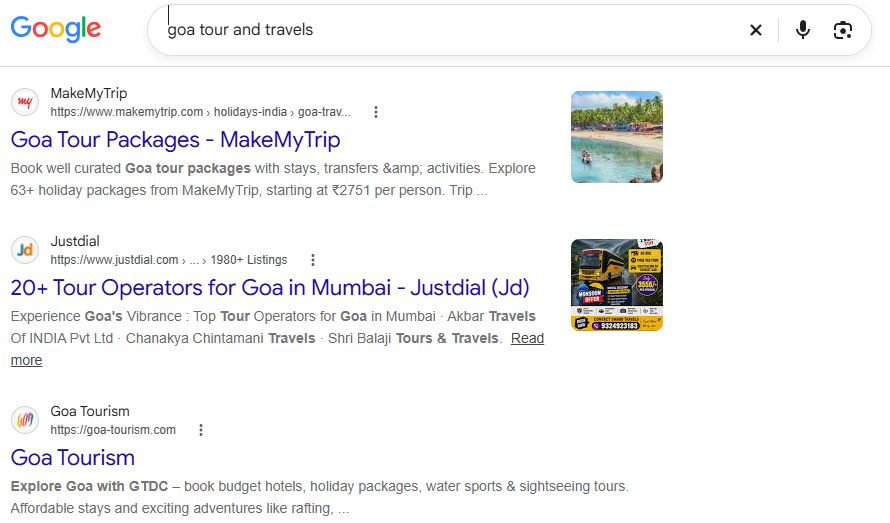
Search engine optimization is more than simply adding keywords to a travel website. Effective SEO focuses on understanding what travelers want to know and providing useful, trustworthy information that matches their search intent.
For travel businesses, SEO can help attract visitors before they are ready to make a booking.
Targeting the Right Travel Keywords
Travel businesses should build their keyword strategy around the different stages of the traveler’s journey.
For example, someone researching a destination may search:
- Best places to visit in Mumbai
- Things to do in Kerala
- Best time to visit Bali
- Places to visit in Rajasthan
A traveler closer to making a purchase may search:
- Kerala tour packages
- Bali holiday packages
- Best hotels in Goa
- Dubai travel packages
These searches have different intentions.
A good SEO strategy can create content for both informational and commercial searches instead of focusing exclusively on highly competitive booking keywords.
Creating Destination-Focused Content
Destination-focused content can help travel businesses attract users who are still researching their trip.
Useful topics include:
- Best places to visit
- Things to do
- Best time to visit
- Travel costs
- Local transportation
- Food recommendations
- Suggested itineraries
- Family travel guides
- Couple travel guides
- Adventure travel guides
For example, a business promoting Kerala tourism could create an extensive guide covering Kochi, Munnar, Alleppey, Thekkady, Wayanad, and other relevant destinations.
The content can then naturally link to relevant services or packages offered by the business.
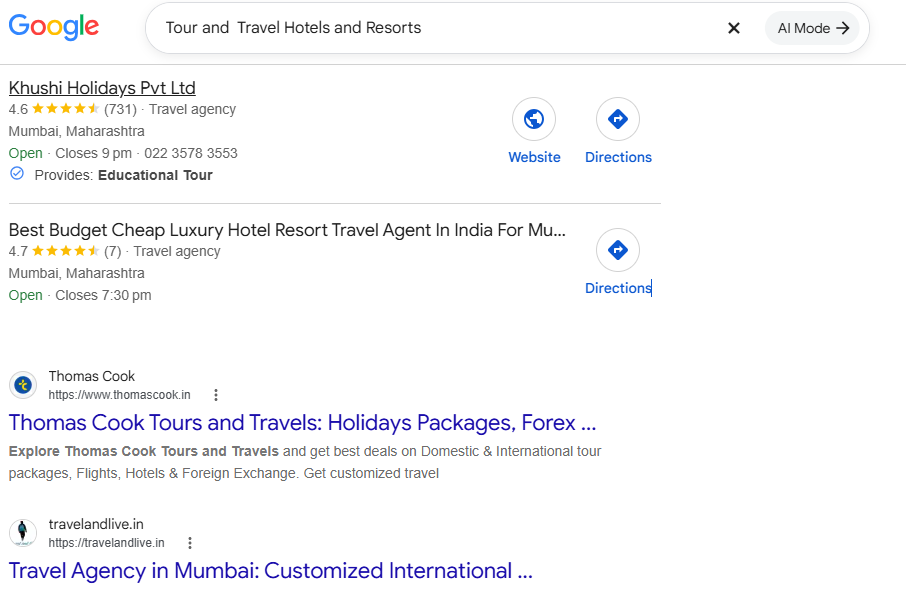
Local SEO for Hotels, Tour Operators and Travel Agencies
Local SEO is particularly relevant when customers search for travel services in a specific location.
A travel agency located in Mumbai, for example, may want to appear for searches related to travel agencies and tour packages in Mumbai.
Important local SEO activities can include:
- Maintaining an accurate Google Business Profile
- Collecting genuine customer reviews
- Adding relevant business information
- Publishing useful updates
- Optimizing location pages
- Maintaining consistent business information online
- Creating location-specific content
For hotels and tourism businesses, local visibility can be especially valuable because travelers often search for businesses near specific destinations.
Social Media Strategies for Travel Brands in 2026
Social media is not simply a promotional channel for tourism businesses. It can also function as a discovery, inspiration, engagement, and community-building platform.
Travel brands can use social media to show potential customers what makes a destination or experience worth exploring.
Create Visual Travel Content
Travel marketing should take advantage of the visual nature of the industry.
Instead of repeatedly publishing promotional posters, brands can create content around experiences.
For example:
- Sunrise and sunset locations
- Local cuisine
- Hidden attractions
- Cultural experiences
- Hotel experiences
- Adventure activities
- Local markets
- Travel tips
A travel brand can also create recurring content series such as “Destination of the Week”, “Travel Tip Tuesday”, or “Weekend Getaway Ideas.”
Consistent formats can make content production easier while giving audiences a reason to return.
Use Short-Form Videos and Reels
Short-form video can communicate travel experiences quickly.
Examples include:
“3 Places to Visit in Goa This Weekend”
“5 Things to Know Before Visiting Dubai”
“A 30-Second Tour of Our Resort”
“What to Pack for a Himalayan Trip”
The key is to provide information or inspiration rather than making every video a direct advertisement.
Encourage User-Generated Content
Customers can become valuable content contributors.
A hotel might encourage guests to share photographs from their stay. A tour company could invite travelers to share their favorite moments from a trip.
With appropriate permission, selected content can be featured on the brand’s social channels.
This can help create a community around the brand and provide prospective customers with real-world examples of the experience.
Use Stories, Polls and Interactive Content
Social media stories can be useful for quick interactions.
Travel brands can ask questions such as:
“Beach holiday or mountain holiday?”
“Which destination would you visit next?”
“Budget trip or luxury escape?”
Polls, quizzes, question stickers, countdowns, and other interactive features can encourage participation and provide businesses with insights into audience interests.
The Role of AI in Travel and Tourism Marketing
Artificial intelligence is becoming increasingly relevant to digital marketing.
Travel businesses can use AI-based technologies for tasks such as customer support, content assistance, data analysis, personalization, and recommendations.
However, AI should support human expertise rather than replace accurate travel information and responsible decision-making.
AI-Powered Travel Recommendations
Travelers have different interests and requirements.
One person may want luxury accommodation, while another may prefer budget travel. One traveler may prioritize adventure, while another may be interested in food and culture.
AI-powered systems can analyze relevant customer preferences and help provide more personalized recommendations.
For example, a tourism platform could recommend destinations based on:
- Previous searches
- Travel interests
- Budget preferences
- Trip duration
- Preferred activities
Businesses should ensure that personalization is based on appropriate data practices and applicable privacy requirements.
AI for Content Creation
AI tools can assist marketers with:
- Content ideas
- Article outlines
- Social media concepts
- Email drafts
- Ad variations
- Keyword clustering
- Content optimization
However, travel content should be reviewed carefully before publication.
Information such as prices, opening hours, visa requirements, transportation details, hotel facilities, and travel regulations can change. Businesses should verify important information rather than publishing AI-generated information without review.
Personalized Travel Marketing
AI and customer data can also support personalization.
For example, a business could provide different recommendations to:
- Family travelers
- Solo travelers
- Couples
- Business travelers
- Luxury travelers
- Adventure travelers
Personalization can make digital communication more relevant when it is implemented responsibly.
Chatbots and AI Customer Support
Travel businesses often receive repetitive questions.
Customers may ask:
- What is included in the package?
- What is the cancellation policy?
- What documents are required?
- What is the trip duration?
- Are airport transfers included?
- What activities are available?
A chatbot can help answer common questions and direct customers to appropriate resources.
For complex requests, the conversation can be transferred to a human representative.
Personalization in Travel Digital Marketing
Travel decisions are highly personal. Two customers searching for the same destination may want completely different experiences.
Personalization allows businesses to make their communication more relevant.
Personalized Destination Recommendations
A website could recommend destinations based on the user’s interests, where appropriate.
For example:
Adventure traveler: Trekking, rafting and hiking destinations.
Family traveler: Family-friendly resorts and activities.
Luxury traveler: Premium hotels, private tours and exclusive experiences.
Targeted Advertising
Advertising platforms allow businesses to create campaigns for defined audience segments, subject to platform rules and applicable privacy requirements.
A tourism company can create separate campaigns for different travel interests instead of using exactly the same message for every audience.
Customized Email Campaigns
Email campaigns can also be segmented.
Instead of sending every subscriber the same message, businesses can organize audiences according to relevant preferences and previous interactions.
The result can be more relevant communication and less unnecessary promotional content.
Mobile Marketing for Travelers
Travelers increasingly use smartphones throughout the travel journey.
They may use their phones to:
- Search for destinations
- Compare hotels
- Read reviews
- Navigate
- Make reservations
- Contact businesses
- Check itineraries
- Watch travel videos
For this reason, mobile optimization should be a fundamental part of tourism marketing.
Mobile-Friendly Travel Websites
A travel website should be easy to use on smaller screens.
Important elements include:
- Fast loading
- Easy navigation
- Readable text
- Clear calls to action
- Simple inquiry forms
- Easy access to contact information
- Secure booking functionality
If users struggle to navigate a website on their phones, they may leave before making an inquiry or booking.
Mobile Search Optimization
Travelers frequently search for information while they are already traveling.
Examples include:
- Restaurants near me
- Hotels near the airport
- Things to do nearby
- Tourist attractions near me
- Taxi services near a destination
This makes local SEO and mobile-friendly content particularly relevant.
WhatsApp Marketing and Communication
For businesses operating in markets where WhatsApp is widely used, it can be a useful communication channel.
Travel businesses can use appropriate messaging workflows for:
- Customer inquiries
- Booking confirmations
- Travel updates
- Customer support
- Documents and information
- Follow-ups
Businesses should obtain appropriate consent where required and respect platform policies and customer preferences.
Digital Marketing Strategies for Different Travel Businesses
Not every tourism business needs the same digital marketing strategy.
Travel Agencies
Travel agencies can focus on:
- Local SEO
- Google Business Profile
- Destination landing pages
- Google Ads
- Social media
- WhatsApp communication
- Travel blogs
- Customer reviews
They can also create separate landing pages for popular destinations and travel categories.
Hotels and Resorts
Hotels can focus on:
- Local SEO
- Hotel SEO
- Professional photography
- Video marketing
- Google search visibility
- Social media
- Reviews
- Direct booking campaigns
- Email marketing
A hotel website should make it easy for users to understand rooms, facilities, location, policies, and booking options.
Tour Operators
Tour operators can create content around complete experiences.
For example:
- Adventure tours
- Wildlife tours
- Family vacations
- Honeymoon packages
- Cultural tours
- Group tours
Video content and customer-generated content can be particularly useful for demonstrating what the tour experience looks like.
Airlines
Airlines operate at a much larger scale and can use digital marketing for:
- Destination inspiration
- Promotional campaigns
- Loyalty programs
- Personalized communication
- Mobile applications
- Search marketing
- Social media
- Customer support
Their digital strategy can cover the entire customer journey, from destination discovery to post-flight engagement.
Tourism Boards and Destinations
Tourism boards can use digital marketing to promote destinations rather than individual businesses.
They can publish:
- Destination guides
- Attractions
- Cultural information
- Events
- Local cuisine
- Travel routes
- Seasonal experiences
- Safety and practical travel information
The goal is to help travelers understand why a destination may be relevant to their interests.
How to Build a Digital Marketing Strategy for a Travel Business
A successful tourism marketing campaign requires more than randomly posting on social media or running advertisements.
Businesses should start with clear objectives.
Step 1: Define Your Target Audience
Identify who you want to reach.
Consider factors such as:
- Age group
- Location
- Travel interests
- Budget
- Travel frequency
- Family or solo travel
- Domestic or international travel
A clearly defined audience makes it easier to develop relevant content and campaigns.
Step 2: Research Your Competitors
Study how competing travel businesses present themselves online.
Look at:
- Website structure
- SEO content
- Social media activity
- Reviews
- Advertisements
- Destination pages
- Offers
- Customer communication
The purpose is not to copy competitors but to understand the market and identify opportunities for useful differentiation.
Step 3: Select the Right Digital Channels
A small local travel agency may not need to invest heavily in every available platform.
It could initially focus on:
- SEO
- Local SEO
- Google Ads
- Content marketing
A larger tourism brand may require a broader strategy.
The right channel mix depends on the target audience and business objectives.
Step 4: Create a Content Strategy
Develop a content calendar covering different types of content.
For example:
Monday: Travel tip
Wednesday: Destination guide
Friday: Short-form travel video
Sunday: Customer story
A content calendar can improve consistency and make it easier to coordinate website and social media activities.
Step 5: Set a Marketing Budget
Digital marketing budgets can be divided among areas such as:
- SEO
- Content creation
- Paid advertising
- Social media
- Influencer campaigns
- Website development
- Marketing tools
Businesses should define the purpose of each investment and track performance.
Step 6: Launch and Monitor Campaigns
Once campaigns are launched, performance should be monitored regularly.
Metrics can reveal:
- Which destinations receive the most interest
- Which content attracts traffic
- Which ads generate inquiries
- Which landing pages convert visitors
- Which channels bring qualified leads
Step 7: Analyze and Improve Results
Digital marketing should be treated as an ongoing process.
Businesses can test different:
- Headlines
- Images
- Videos
- Offers
- Calls to action
- Landing pages
- Audience segments
The results can then inform future campaigns.
Key Digital Marketing Metrics for Travel Businesses
Measuring performance is essential because traffic and social media followers alone do not necessarily represent business results.
Important metrics include:
Website Traffic
Measures the number of visitors reaching the website.
Search Rankings
Track visibility for important travel-related keywords.
Leads and Inquiries
Measures how many users contact the business.
Booking Conversion Rate
Shows the percentage of relevant visitors who complete a booking or desired action.
Cost Per Lead
Useful for evaluating paid campaigns.
Return on Advertising Spend (ROAS)
Helps businesses evaluate revenue generated in relation to advertising expenditure, where reliable revenue attribution is available.
Social Media Engagement
Can include:
- Likes
- Comments
- Shares
- Saves
- Video views
- Profile visits
Email Performance
Useful metrics include:
- Open rate
- Click-through rate
- Conversion rate
- Unsubscribe rate
The exact metrics that matter most will depend on the business model and campaign objective.
Common Digital Marketing Mistakes in the Travel Industry
Even businesses investing in digital marketing can make avoidable mistakes.
Ignoring SEO
A beautiful website is not enough if potential customers cannot discover it through relevant searches.
Having an Outdated Website
Travelers expect websites to provide current and useful information.
Outdated packages, inaccurate prices, broken links, and old contact information can damage trust.
Focusing Only on Promotional Content
Constantly telling people to “Book Now” can make social media repetitive.
Travel brands should balance promotional posts with educational, inspirational, and entertaining content.
Not Responding to Reviews
Ignoring customer feedback can create a poor impression.
Businesses should respond professionally and address legitimate concerns appropriately.
Ignoring Mobile Users
A website that works well on desktop but performs poorly on smartphones can create unnecessary friction.
Poor Social Media Consistency
Posting frequently for a few weeks and then disappearing for months makes it difficult to build a consistent audience.
Not Tracking Marketing Results
Without analytics and conversion tracking, businesses may spend money without understanding which activities are producing meaningful results.
Future of Digital Marketing for Travel and Tourism
The travel industry will continue to evolve alongside digital technology.
Several developments are likely to remain important for tourism marketers.
AI and Automation
AI can assist businesses with customer support, personalization, content workflows, data analysis, and recommendations.
Human oversight will remain important, particularly when dealing with factual travel information and customer service.
Personalized Experiences
Travelers increasingly expect information and recommendations that are relevant to their interests.
Businesses that understand their audiences can create more targeted experiences across websites, email, advertising, and other channels.
Video-First Marketing
Video will continue to be an important way of communicating destinations and experiences.
Travel brands can use both short-form and long-form video depending on the platform and marketing objective.
Voice and Conversational Search
As users increasingly interact with digital assistants and conversational interfaces, travel businesses may need to consider how their content answers natural-language questions.
Instead of only targeting short keywords, content can also address complete questions such as:
“What are the best places to visit in Mumbai for a two-day trip?”
Virtual and Immersive Travel Experiences
Technology can also provide travelers with immersive previews of destinations, hotels, attractions, and experiences.
Virtual tours, interactive maps, 360-degree experiences, and other immersive formats may help customers understand what they can expect before booking.
Data-Driven Marketing
Data can help tourism businesses understand customer behavior and campaign performance.
When collected and used responsibly, data can support better decisions about:
- Content
- Advertising
- Audience segments
- Destinations
- Customer communication
- Website optimization
Frequently Asked Questions
What is digital marketing for travel and tourism?
Digital marketing for travel and tourism involves using online channels such as SEO, social media, content marketing, paid advertising, email, video, and digital technologies to promote travel services, destinations, accommodation, and tourism experiences.
Why is digital marketing important for tourism businesses?
Digital marketing helps tourism businesses become visible to travelers during different stages of the travel planning process, from destination research to booking and post-trip engagement.
What are the best digital marketing strategies for travel agencies?
Travel agencies can use a combination of SEO, local SEO, destination content, social media, Google Ads, video marketing, reviews, email marketing, and customer communication channels such as WhatsApp.
How can SEO help travel businesses attract more customers?
SEO can help travel businesses appear in relevant search results when people research destinations, travel services, hotels, activities, and travel packages.
How is AI changing travel marketing in 2026?
AI can assist with personalization, customer support, content workflows, data analysis, recommendations, and automation. Businesses should verify AI-generated information before publishing important travel details.
Conclusion
Digital marketing has become an important part of how travel and tourism businesses connect with modern travelers.
In 2026, travelers can discover destinations through search engines, social media, videos, reviews, online communities, advertisements, and personalized recommendations. This means tourism businesses need to think beyond traditional advertising and create a digital presence that supports the entire customer journey.
A strong digital marketing for travel and tourism strategy can combine SEO, content marketing, social media, paid advertising, influencer marketing, email, video, mobile optimization, personalization, and emerging AI technologies.
However, the goal should not simply be to generate more online visibility. Successful tourism marketing should provide useful information, communicate authentic experiences, build trust, and make it easier for travelers to take the next step.
Travel businesses that understand their audiences, create valuable content, monitor their performance, and continuously adapt their digital strategies can build a stronger connection with travelers in an increasingly digital marketplace.
Ultimately, the future of travel and tourism marketing will be shaped by the combination of technology and human experiences. Digital platforms can help travelers discover and plan their journeys, but useful information, authentic experiences, reliable service, and customer trust remain central to the travel industry.
For this travel marketing guide